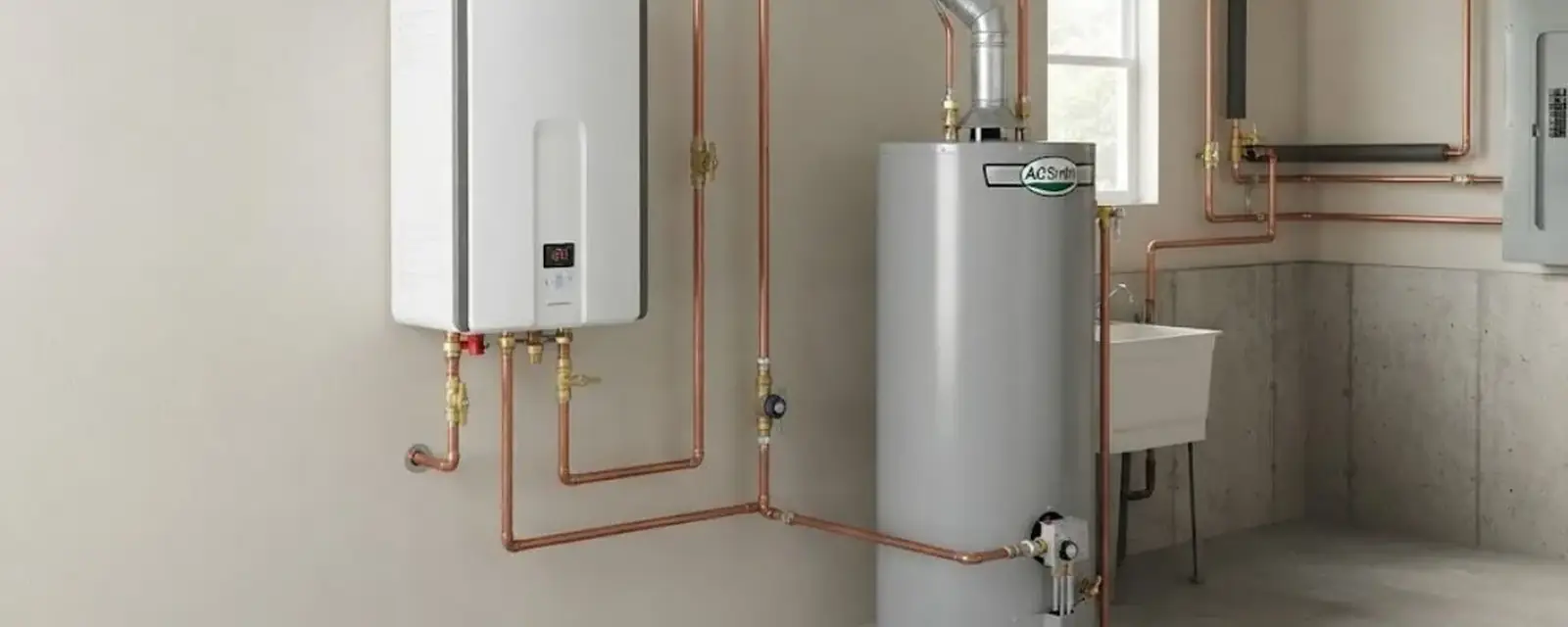
The tankless water heater you need depends on three things: how much hot water you use at the same time, how much the incoming water must be heated, and whether your home can support the gas line, venting or electrical service the unit requires. Get those three right and the rest is a choice of brand and size.
This guide is for Carteret, NJ homeowners comparing a tankless heater to a traditional tank. We explain how to size a unit, the difference between gas and electric, what Carteret's water and gas supply mean for your choice, and the questions to settle before a plumber quotes the job.
Step one: count your peak hot water demand
Tankless heaters are sized by flow, not by tank volume. Flow is measured in gallons per minute, and what matters is how many fixtures run at the same moment. A home with two showers and a dishwasher running together needs a larger unit than a one-bath home.
- Bathroom shower: usually the largest single demand.
- Kitchen faucet and dishwasher: modest, but they often overlap with a shower.
- Washing machine: uses hot water for some cycles.
- Tub filling: a large volume, but briefly.
- Count only what can run together, not every fixture in the house.
Step two: the temperature rise
A tankless heater must raise the temperature of cold incoming water to the setting you use. The difference is the temperature rise. In winter the incoming water is colder, so the same unit delivers less hot water than it does in summer.
New Jersey defines hot water as 120 to 140 degrees Fahrenheit, which is a useful range for sizing. Size for the coldest months, not the easy ones, and a unit that works in January will work all year.
Gas, electric or hybrid: how the options compare
Fuel type usually decides the price, the installation work and the size of the unit you can fit. Here is how the options compare in a typical home.
| Type | Best for | What the home needs | Watch for |
|---|---|---|---|
| Natural gas. | Larger homes, several showers. | Adequate gas line and a proper vent. | Venting and gas line upgrades. |
| Electric. | Small homes, apartments, point-of-use. | Heavy electrical circuits and a panel with spare capacity. | Panel upgrades, lower flow in winter. |
| Propane. | Homes without natural gas. | Propane tank and venting. | Fuel supply logistics. |
| Condensing gas. | High efficiency use. | Drain for condensate and plastic venting. | Condensate drain placement. |
We confirm the gas line size, vent path and panel capacity on site before recommending a model.
What to settle before you ask for a quote
These questions keep quotes comparable and prevent surprises after the old tank is gone.
Fuel and supply.
Is natural gas available at the heater location, and is the line large enough for a tankless unit?
Venting.
Where will exhaust leave the house, and does the path meet the manufacturer's rules?
Water quality.
Is there a water softener or a plan for yearly descaling?
Space and access.
Is there room on the wall for the unit, shutoffs and a condensate drain?
Is tankless the right choice at all?
A tankless heater saves floor space and heats on demand, but it is not right for every house. It costs more at the start, it needs service, and a poorly sized unit can disappoint a busy household. In a small apartment or a home with modest demand, a standard tank may still be the simpler answer.
If your heater is failing now, compare both. Our tankless water heater team can size a unit, and our water heater replacement crews can price a like-for-like tank so you can decide with both numbers in hand.
- Tankless often suits households with long gaps between hot water use.
- A tank may suit very small homes or tight budgets.
- Either type needs correct venting and a permit decision made early.
Maintenance: the part people forget
A tankless heater has narrow passages that scale in hard water, so yearly descaling is a normal part of owning one. Skipping it shortens the life of the unit and cuts its flow. A service plan is worth planning for before you buy.
Ask your installer for the descaling interval, the filter screen location and the error codes you may see. A good installation includes isolation valves so the unit can be flushed without hiring someone each time.
Comparing the real cost of ownership
The sticker price is only part of the picture. A tankless unit usually costs more to buy and install, but it avoids the standby loss of a tank that keeps water hot all day. How much that matters depends on how much hot water you use, so a household that is often away will see more benefit than one with a full house.
Add the costs that are easy to overlook: a larger gas line, new venting, a condensate drain, an electrical upgrade for electric models and a yearly descaling visit. Ask for a quote that lists each one so you can compare the full price of different options.
Common sizing mistakes
The most common mistake is sizing for the summer. A unit that handles two showers in July may deliver lukewarm water for one shower in a cold January. Always check the rated flow at your winter temperature rise, not the headline number on the box.
The second mistake is ignoring simultaneous use. If a teenager showers while the dishwasher runs and someone starts a load of laundry, the unit sees all three at once. Add a margin so a normal morning does not push it to its limit.
Water and gas in Carteret that affect tankless sizing
Carteret's water comes from Middlesex Water Company. In the utility's annual water quality report, hardness averages about 101 parts per million, roughly six grains per gallon, with a system range of 12 to 314. Harder water scales a tankless heat exchanger faster, so read your own report and budget for descaling.
Most Carteret homes with gas get natural gas from PSE&G. If you ever smell gas near a heater, leave immediately, move at least 350 feet away and call PSE&G at 1-800-880-PSEG (7734) or 911. Do not look for the source or use a phone near the leak.
Permit rules vary, so ask the Carteret construction office or your plumber how a tankless install will be handled. A gas line or vent change is rarely a swap-only job.
Source type: Utility water quality report and PSE&G gas safety page. Sources: Middlesex Water Company annual water quality report. PSE&G: if you smell gas.
Code and safety references for this topic
Tankless installs follow the National Standard Plumbing Code that New Jersey adopts through N.J.A.C. 5:23-3.15, and gas units involve PSE&G's service. Permit rules vary, so ask the borough construction office.
Questions readers ask
How do I know what size tankless heater I need?
Add up the gallons per minute of fixtures that run at once, then match that to the unit's rated flow at your winter temperature rise. A plumber confirms this on site.
Can my house support a gas tankless heater?
It depends on the gas line size, the meter and the vent path. Many homes need a line upgrade, which is why we check before quoting.
Does hard water hurt a tankless heater?
Yes, scale builds on the heat exchanger. Annual descaling and, where needed, a softener help. Check the hardness in your own Middlesex Water report.
Is tankless better for a rental property in Carteret?
It can be, since it saves floor space and removes the risk of a tank leak. Landlords still need to plan for descaling and confirm the gas and vent setup first.
Do you install tankless heaters in Port Reading and Fords?
Yes. We dispatch to Port Reading and Fords from Carteret and confirm the gas, vent and space before any quote.