
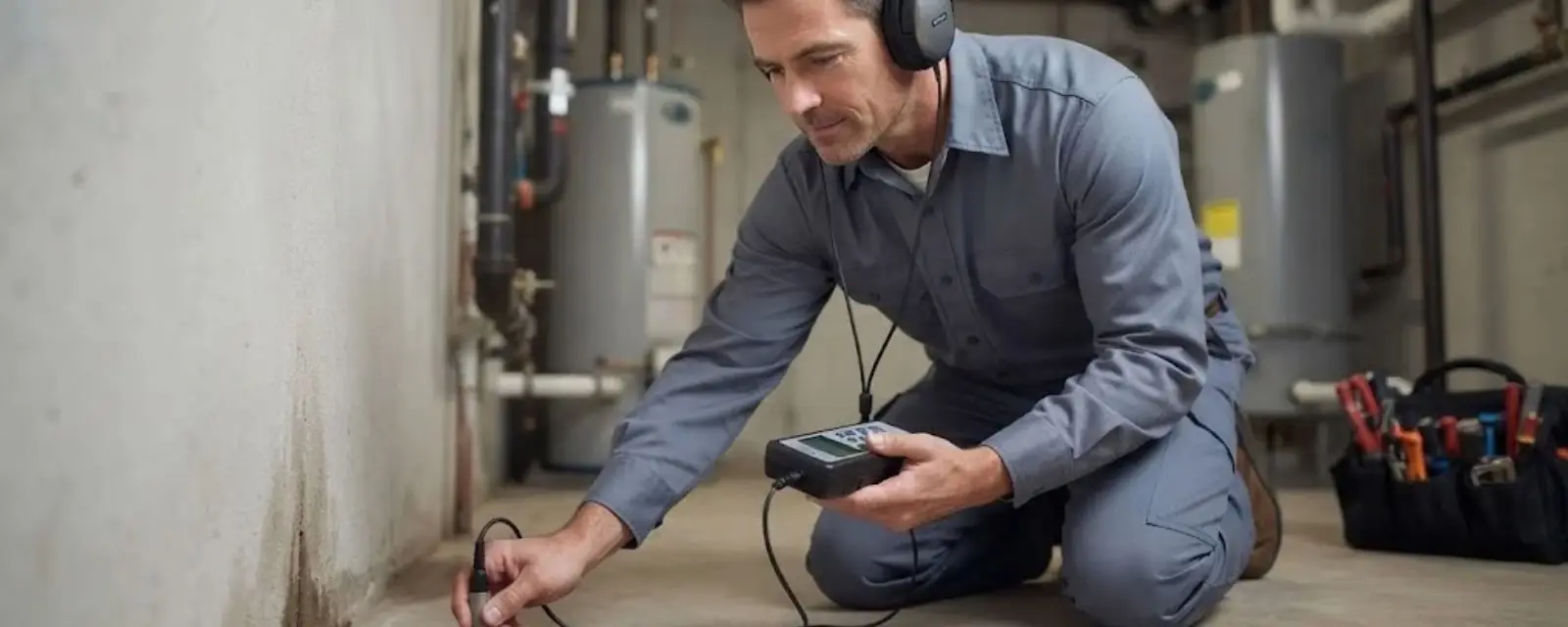
Leak detection in Carteret, NJ is the work of finding where water is escaping when you cannot see it: inside a wall, under a slab, behind a tub or in the buried pipe between the street and your house. If water is already stained through a ceiling or pooling on a floor, our 24/7 line is open. Shut the main valve first, then call.
A hidden leak rarely announces itself. It shows up as a water bill that climbs for no reason, a meter that keeps moving when every tap is off, a warm patch on a floor, or a musty smell in a closet. We use non-invasive methods first so the wall or floor is opened only where the evidence points, and we tell you what we found in plain words.
Active leak or water coming through a ceiling: what to do first
Water behind a surface keeps spreading while you decide what to do. The first minutes matter more than the diagnosis, and none of these steps need a tool. Nights and weekends are the same as any other time here, because the line is staffed around the clock and same-day appointments are booked whenever we can.
- Close the main shutoff where the line enters the house, usually in the basement, a utility closet or near the water meter.
- If a ceiling is bulging with water, place a bucket under it and poke a small hole at the lowest point of the bulge so it drains in a controlled way instead of collapsing.
- Switch off breakers for any room where water is near outlets or light fixtures, but only if you can reach the panel without stepping in water.
- Photograph the stain and the meter dial before you touch anything. Those pictures help us, and they help your insurer.
Signs that a leak is hiding somewhere in the house
Hidden leaks leave small clues long before they cause a ceiling to fail. Reading them early is the cheapest part of the whole job, so it pays to know what to look for.
None of these signs proves a leak by itself. Two or three together make a strong case, and a quick meter check can settle the question in about fifteen minutes.
- A water bill that rises with no change in how many people live in the house.
- The meter dial or low-flow triangle still turning after every fixture and appliance is off.
- Floors that feel warm, soft or damp, or flooring that is lifting at the seams.
- Paint that bubbles, drywall that stains or a musty smell that returns after cleaning.
- The sound of running water when the house is quiet, or a toilet that refills by itself.
The fifteen-minute meter test you can run yourself
Before anyone arrives you can tell whether water is leaking at all, and roughly which side of the house it is on. This takes no tools and tells us where to start.
Stop all water use.
Turn off taps, the ice maker, the washer and the dishwasher. Make sure no one flushes a toilet.
Read the meter.
Find the meter and note the dial or the small leak indicator. If it moves, water is going somewhere.
Close the main and wait.
Shut the main valve and check the meter again. If it still moves, the leak is on the supply side before the valve.
Call with what you saw.
Tell the dispatcher whether the meter moved with the main open, closed or both. That narrows the search before we load the truck.
Which detection method finds which kind of leak
No single tool finds everything. We pick the method from the symptom, and on a tricky house we combine two so each one confirms the other.
| Method | Best for | How it works | Limit to know |
|---|---|---|---|
| Acoustic listening. | Pressurized pipes in walls, floors and under slabs. | Sensitive microphones pick up the hiss of escaping water along the pipe. | Background noise and plastic pipe can dampen the signal. |
| Moisture meter and thermal imaging. | Wet drywall, ceilings and subfloors. | Reads moisture and surface temperature differences without cutting. | Shows wet areas, not always the exact joint that failed. |
| Pressure test. | Isolating one branch or the whole supply. | Gauge holds the line under pressure and a drop confirms a leak. | Confirms a leak exists, then another method places it. |
| Tracer gas. | Buried lines and sealed cavities. | A harmless gas is pushed through the pipe and sensed at the surface. | Needs the line to be drained and isolated first. |
| Camera inspection. | Drains and sewer lines. | A small camera shows cracks, offsets and root entry. | Looks at drain pipes, not pressurized supply lines. |
We confirm a suspected leak with a second method before recommending that any wall or floor be opened.
Slab leaks, wall leaks and leaks you can hear but not see
A leak under a concrete slab often shows up as a warm spot on a floor, a hot water bill that jumps or the sound of water running under tile. Hot lines leak more often than cold because heat and cold cycles stress the metal, so a warm floor is a clue to take seriously.
A leak inside a wall may be a supply line, a drain or a fitting behind a tub. We trace the wet area outward from the stain, because water travels along framing and pipes and the damp spot is rarely directly below the failure.
When we find the source, the repair follows the problem. A pinhole in an accessible line is a quick fix, while a failing run that keeps leaking may be a case for repiping the section instead of patching it again.
Why a high water bill is not always a leak
A rising bill sends many people straight to a leak call, and sometimes that is right. Other times the cause is a running toilet, an outdoor spigot left slightly open, a new habit or a seasonal change such as filling a pool or watering a lawn.
The meter test above separates the cases quickly. If the meter is still, the water is being used, not lost. If it moves with everything off, we have a real leak and the next step is finding it. A toilet that runs on its own is often a cheap fix handled under toilet repair.
- Meter still with all water off: usage, not a leak.
- Meter moves with the main open and stops with it closed: leak inside the house.
- Meter moves even with the main closed: check the main valve itself and the line before it.
Carteret's water main work and what it means for a hidden leak
Middlesex Water Company's RENEW 2023 project replaced about 26,000 feet of main in Carteret and part of Port Reading, with new service lines, valves and hydrants. Streets on the list included Arthur Avenue, Ash Street, Birch Street, Coolidge Avenue, Jackson Avenue, Mulberry Street, Spruce Street and Willow Street.
If your block was on that list, the connection from the street to your house was reworked and the meter may be moving from inside the home to an exterior below-ground pit. That moves the utility's connection point outside, but the pipe from the pit to your wall is still yours. A leak on that stretch will make the meter spin with everything off.
If the leak is outside the meter, call Middlesex Water at 800-549-3802. If it is after the meter, it is ours to find, and our water service line repair crew can fix the buried section once it is located. The work window for RENEW ended in spring 2024, so a new meter spin after that is worth a closer look.
What changes the price of finding a leak
We do not quote a flat figure over the phone, because a pressure test on a ranch house and a search under a slab are very different jobs. You get a clear price before work starts, and these are the factors that move it:
- Where the leak might beExposed basement lines are quick to check. Lines inside finished walls or under slab take more testing.
- Size and layout of the houseA small apartment is a short survey. A multi-level house or a building with several units takes longer.
- Number of methods neededOne listening pass may be enough. A hard case may need acoustic, thermal and pressure testing together.
- Access to the pipeClear shutoffs and open utility rooms speed things up. Sealed chases and finished ceilings slow them down.
- Time of the callNights, weekends and holidays are emergency visits and are priced as such, with the number stated first.
Homeowners insurance often pays for the resulting water damage from a sudden leak but not for a slow leak that went on for months, and some policies pay for the access needed to repair it. Ask your insurer before you decide. For a real number on your house, call (718) 412-8453.
Renters, landlords and shared buildings
With roughly 45 percent of Carteret homes rented, many leak calls begin with a tenant who sees a stain and does not know who is responsible. We give the tenant and the owner or manager the same written account of what was found, which usually settles the question without an argument.
In a multi-unit house, a leak often travels between floors. Tell us which unit is above or below the stain so we check the neighboring bathroom or kitchen. Photos of the stain, the meter and the date help your landlord and any insurer later.
After the leak is found: repair, dry out and follow up
Finding the leak is only half the job. We stop the water, repair or replace the damaged section and test the line again to prove the pressure holds.
Wet materials need to dry out fast, usually within a couple of days, or mold can start. We tell you what is wet and what to do about it, and if the leak came from a burst section we can pair the fix with burst pipe repair. If your water is shut off for the work, we explain how long it will take before we start.
Code and safety references for leak detection
Finding a leak is diagnostic, but repairing it follows the plumbing subcode, N.J.A.C. 5:23-3.15, which adopts the National Standard Plumbing Code. Middlesex Water publishes an annual water quality report and its customer line is 800-549-3802, which is the number to call about meter readings or the utility side of a service line.
Leak Detection questions from Carteret customers
Do you handle leak detection emergencies at night or on weekends in Carteret?
Yes. The line is answered 24 hours a day, including nights, weekends and holidays. If water is coming through a ceiling or the meter is racing, close the main valve and call so we can book a same-day visit when we can.
How do you find a leak without tearing out the wall?
We start with the meter, then use listening gear, moisture meters and thermal imaging to trace the wet area from the outside. A pressure test confirms the suspected line. Walls and floors are opened only at the spot the evidence points to.
My meter keeps moving but I see no water anywhere. What now?
Run the meter test on this page. If the dial moves with the main closed, the leak is likely before the valve. If it stops when the main is closed, the leak is inside the house and we can locate it with a listening survey.
Can you tell if the leak is on my side or the utility's side?
Usually yes. The meter marks the change in responsibility. After the meter the pipe is yours, and before it the leak belongs to Middlesex Water, which you can reach at 800-549-3802. We will tell you honestly which side we find it on.
Is a hidden leak covered by homeowners insurance?
Policies differ. Many cover damage from a sudden burst but not repeated seepage over time, and some cover the cost of reaching the pipe. Read your policy or ask your agent before you decide on repairs.
Do you offer leak detection in nearby towns?
Yes. We dispatch from Carteret to Port Reading, Avenel, Woodbridge Township, Fords and Perth Amboy, and Port Reading is the closest.