
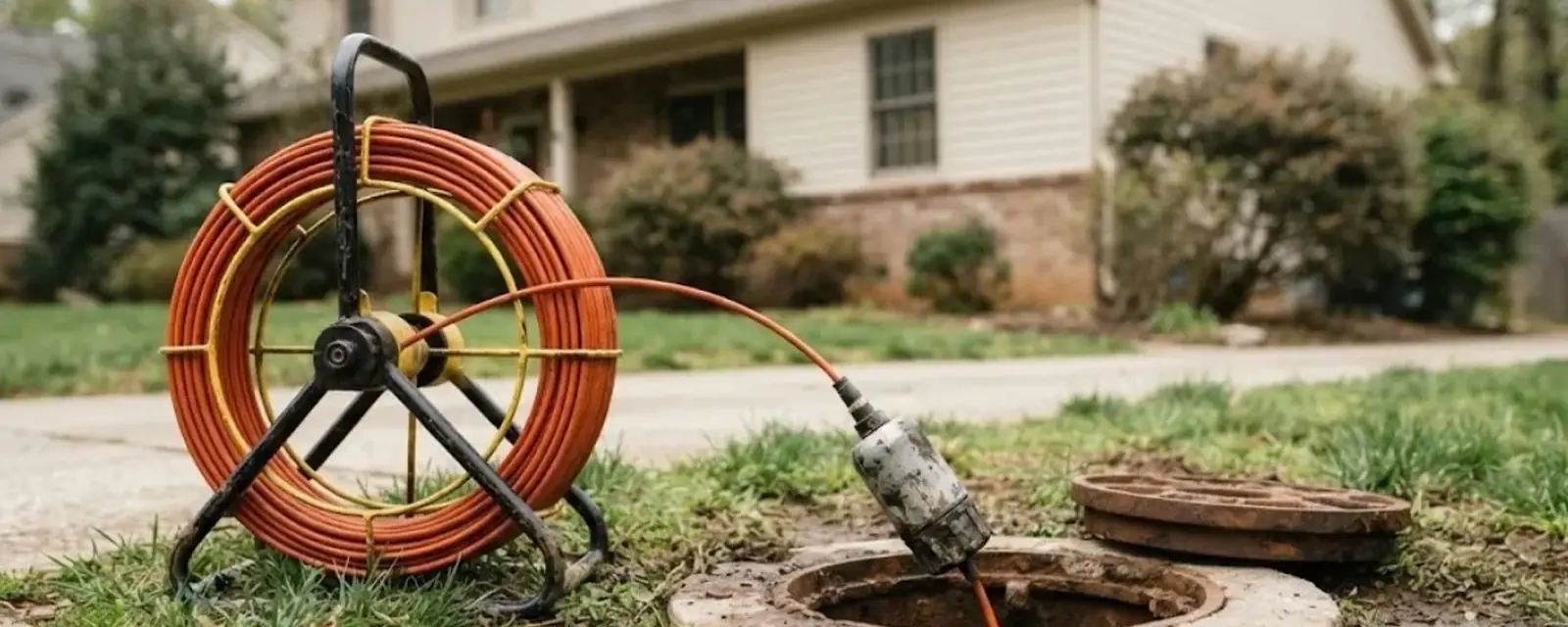
A sewer camera inspection in Carteret, NJ sends a small waterproof camera on a flexible rod through your sewer line so we can see its condition on a monitor. You find out whether the trouble is a clog, a crack, a root mass or a low spot, and you see it yourself before agreeing to any repair. Our 24/7 line takes calls when a backup cannot wait.
The inspection is useful in three situations. Something is wrong and the cause is unclear, a clog keeps returning, or you are about to buy an older house and want to know what is underground. In each case the video replaces guesswork with a plain picture of the pipe.
What the camera can show you
The camera head carries its own light and travels through the line from a cleanout or a removed toilet. As it moves, we watch the pipe wall, the joints and the flow of water. The images are clear enough to tell cast iron from clay from plastic, and to see whether a joint is tight, shifted or open.
Many cameras also carry a locator, a transmitter that lets us pinpoint the camera's position above ground. That turns a vague 'about halfway to the street' into a spot we can mark on the lawn, which saves digging when a repair is needed.
- Cracks, breaks and holes in the pipe wall.
- Roots entering at joints or through damaged sections.
- Bellies, low spots where water and waste sit.
- Offset joints, where one pipe has shifted from the next.
- Scale, grease or debris narrowing the pipe.
- Foreign objects and the exact distance to each problem.
When a camera inspection is worth it
Not every clog needs a camera. This table shows the situations where we recommend one and what we expect to learn.
| Situation | What the camera answers | What happens next |
|---|---|---|
| Main line clogged more than once in a year. | Is the pipe damaged or just dirty? | Cleaning on a schedule or a repair plan. |
| Buying an older house. | Is the lateral sound? | Negotiate, plan repairs or proceed. |
| Wet patch or odor in the yard. | Is the line leaking into the soil? | Locate and mark the break. |
| After a repair or lining. | Did the work close the defect? | Documented proof for your records. |
| Before hydro jetting a line you do not know. | Can the pipe take the pressure? | Jet, or repair first. |
How the inspection works on site
The visit takes a little less time than most people expect, and you can watch.
Find access.
We use a cleanout when there is one, or pull a toilet when there is not.
Run the camera.
We feed the camera down the line toward the street, narrating what appears on the screen.
Mark and measure.
We note the distance to each problem, and use the locator to mark the spot above ground.
Review and record.
You see the footage, we explain what it means and you keep a copy of the video.
Clean first or look first?
A line packed with sludge or paper cannot be inspected until a path is cleared. In that case we open the line with a cable or a gentle drain cleaning pass and then run the camera. If you already know the line is a mess, tell the dispatcher so we bring both tools to the first visit.
On a line with heavy grease or scale, we may recommend hydro jetting after the camera confirms the pipe can take it. Looking first is how we avoid blasting a weak pipe, and it is why the order of the two jobs matters.
Why a camera look is common advice for older Carteret houses
Carteret industrialized around 1890 to 1900, and Charles Canda built many dwellings for Chrome Steel Works workers. We do not know which blocks date from when, and we will not guess. What we can say is that a good share of the borough's housing is older, and older houses are more likely to have aging pipe between the house and the street.
A camera run answers the question for your house in particular. West Carteret also lived under a state sewer ban for 25 years, lifted June 26, 2009, and the borough has since worked on its pump stations. None of that tells you the condition of your private line, which is why a video is more useful than an assumption.
Sources: Borough of Carteret: West Carteret sewer ban lifted (2009).
What affects the cost of a camera inspection
We tell you the price before the camera goes in. The factors that change it are listed here:
- AccessA cleanout at the foundation is quick. Pulling a toilet to get in takes longer.
- Length of the runA short lateral is a fast look. A long run to the street takes more time and cable.
- Cleaning firstA blocked line has to be opened before the camera can pass.
- Locating the problemMarking a defect above ground with the locator is an extra step when you want it.
- Time of the callNights, weekends and holidays are emergency visits and are priced as such, with the number given first.
Many real estate buyers pay for a camera look as part of due diligence. For a price on your house, call (718) 412-8453.
What we will and will not do with the footage
You keep a copy of the video, and we explain it in plain words. If the footage shows a crack, we describe the options in our sewer line repair approach, and we tell you honestly when the defect is minor and monitoring is enough.
We do not use the video to frighten anyone into work. A slightly rough joint with no roots may be fine for years, and we say so. If a second opinion would help, you are welcome to show the recording to another plumber.
Reading the footage with us
Sewer video looks confusing until someone points out what matters. A faint line along the top of a clay pipe is usually a hairline crack, while a dark gap at a joint means the sections have pulled apart. Brown fibers hanging in the stream are roots, and a pool that never drains marks a belly.
We stop the camera at each of these and describe it in everyday words, with the distance from the cleanout. If you are coordinating with an insurer, a seller or a landlord, that running commentary on the recording is often the clearest record you can hand over.
Inspections for buyers, sellers and landlords
Buyers use a camera look to see what a general home inspection cannot, since inspectors rarely have access to the buried pipe. Sellers use it to answer questions before they come up. Landlords with several units use a recording to document the line before a tenant change.
Calls come from across the area. Fords and Woodbridge Township houses are common requests, and the work is the same in each. Ask when you call whether a same-day slot is open.
Code and safety references for sewer camera inspection
A camera inspection is diagnostic and needs no permit on its own, but any repair it leads to falls under the plumbing subcode, N.J.A.C. 5:23-3.15, which adopts the National Standard Plumbing Code. Keep the recording, since it documents the pipe's condition for a repair estimate or a sale.
Sewer Camera Inspection questions from Carteret customers
How long does a sewer camera inspection take?
A straightforward line takes a short visit. A long run, a blocked line or a line with no cleanout takes longer. We tell you what to expect once we see the access point.
Can the camera find where a leak is?
It shows cracks and breaks in the pipe wall and, with a locator, marks their position above ground. A leak inside the water supply system is a different problem, handled by leak detection.
Do I get a copy of the video?
Yes. You keep the recording, and we walk through what each section shows so you can use it with an insurer, a buyer or another contractor.
Can you inspect the line before I buy a house?
Yes. A camera run is a common step for buyers of older houses. We need access to a cleanout or a toilet, so the seller or agent must allow entry.
Is a camera inspection needed after every clog?
No. A single clog in a sink does not need one. We recommend a camera when a main line backs up more than once, when the cause is unclear or when you plan a repair.
Does the camera work at night in an emergency?
Yes, we can run a camera on an emergency visit if a backup needs a diagnosis. Call the 24/7 line and tell the dispatcher it is a main line problem.