
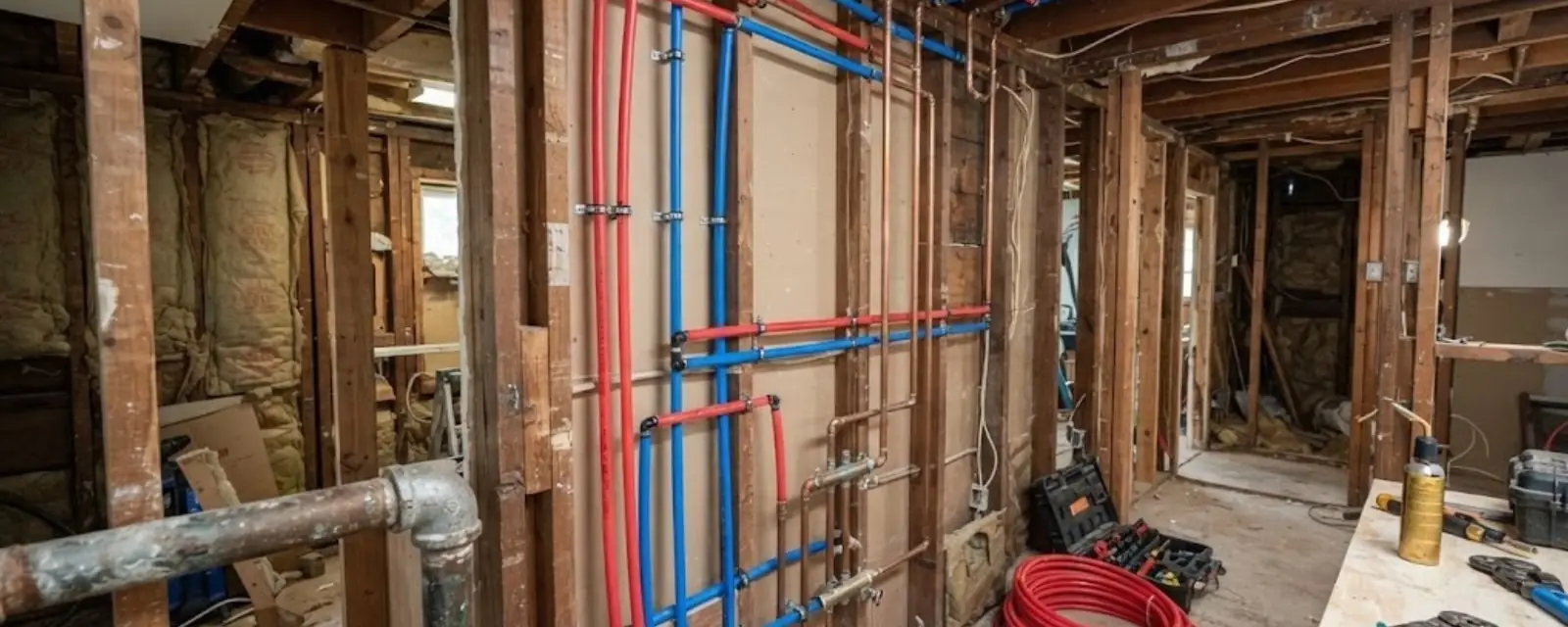
Repiping in Carteret, NJ means replacing the supply pipes that carry water through your house when they are worn out, not just patching the next leak. The usual reasons are rusty water, weak pressure and repeated leaks in old galvanized steel or aging copper. Our 24/7 line takes calls if a failing pipe has already let go.
Most repipe jobs are planned, not rushed. We look at the pipe, test the pressure, count the failures and explain whether a section or the whole house needs work. You get a clear price before work starts and a plan that keeps the water off for as short a time as possible.
Signs that patching has stopped making sense
Every pipe has a service life. When failures start to come every few months, each repair buys less time than the last, and the repair bills begin to add up.
These are the signs that usually mean the line itself, not one fitting, is the problem. If you are unsure whether a leak is hidden, a leak detection visit can confirm it first.
- Brown or rusty water from taps, especially after the water has sat overnight.
- Pressure that is weak on every fixture and does not improve after cleaning aerators.
- Pinhole leaks, green crusty spots or white mineral buildup on pipes.
- A second or third leak in the same line within a year or two.
- Pipe visible in the basement or crawl space that is flaking, bulging or visibly narrowed.
Pipe materials compared: what each means for a repipe
The material you have decides how likely failures are and what replacing it looks like. Here is a general guide, not a promise about any one house.
| Material | Common trouble | How it ages | Usual path |
|---|---|---|---|
| Galvanized steel. | Rust inside, reduced flow, rusty water. | Narrows from the inside over time. | Replace, often whole house. |
| Copper. | Pinholes, pitting, failed joints. | Can last decades, but aggressive water or flux can shorten it. | Replace damaged runs, keep sound ones. |
| Lead. | Old service lines and some old solder. | Health concern, regulatory focus. | Replace and follow program rules. |
| CPVC or PEX. | Fitting failures, specific bad batches. | Generally long lived when installed well. | Repair, replace only the failing parts. |
We identify the material on site and recommend the least invasive fix that solves the problem.
Whole house, partial or stage by stage
A repipe does not have to be all or nothing. If only the kitchen and one bathroom line are failing, replacing those and leaving sound pipe alone is a reasonable plan. We tell you honestly when the better value is a partial job.
For a house with old galvanized steel throughout, a whole-house repipe is usually cleaner because new pipe tied to rusty pipe fails again at the joint. We can also work floor by floor if you want to keep part of the house usable while we work.
How a repipe project is planned and carried out
Good planning keeps disruption small. Here is the sequence we follow.
Survey and test.
We trace the lines, test pressure and identify the pipe material in every accessible area.
Plan the route.
We decide which walls, ceilings or floors need access and which can be avoided by running pipe through existing paths.
Permit and schedule.
Permit rules vary, so we confirm with the borough construction office or handle the paperwork as required, and schedule the water shutoff.
Replace and test.
New pipe is installed, fixtures reconnected and the system is pressure tested before any wall is closed.
Patch and finish.
Access holes are patched or left ready for a drywall trade, depending on what you arrange.
Local water and code points that bear on a repipe in Carteret
Middlesex Water supplies Carteret, and its annual water quality report shows system-wide hardness averaging about 101 parts per million with a range of 12 to 314. Harder water tends to deposit scale inside pipes, while soft or aggressive water can eat at metal. Read your own report before you choose a material.
New Jersey plumbing work follows the Uniform Construction Code plumbing subcode, which adopts the National Standard Plumbing Code. The borough's Building, Construction and Land Use Department at 61 Cooke Avenue reviews plans and inspects permitted work, so ask whether your repipe needs a permit. Permit rules vary, so check before work begins.
What makes one repipe cost more than another
A repipe price depends on the house, so we quote only after we see it. The main factors:
- Size of the houseMore bathrooms, floors and fixtures mean more pipe and more connections.
- Pipe material chosenDifferent materials differ in cost and installation effort.
- Access and finishOpen basements are easy. Plaster, tile and finished ceilings take longer.
- Number of fixturesEach fixture needs a supply and a shutoff, and older ones may need replacing.
- Permit and inspectionPermitted work is inspected, which adds scheduling and some paperwork.
Homeowners insurance usually does not pay for a repipe done because of age or wear. Some policies cover water damage from a pipe failure. For your real price, call (718) 412-8453.
Emergencies during a repipe, and what to do tonight
If a worn line bursts before the repipe is planned, shut the main and call the 24/7 line. We can make an emergency repair that night, then schedule the proper work for later. See burst pipe repair for the immediate steps.
Nights, weekends and holidays are open for these calls, and same-day appointments are booked when available.
Renters, landlords and multi-unit buildings
With roughly 45 percent of Carteret homes rented, a repipe often involves an owner or manager. We can coordinate with each unit, schedule shutoffs in advance and keep a written record of what was done for the owner and any inspector.
If you manage several units, ask about staging work so one stack at a time is replaced and other units keep water. Related fixes, such as plumbing installation for new fixtures, can be done in the same visit.
Code and safety references for repiping
Repiping follows the plumbing subcode, N.J.A.C. 5:23-3.15, which adopts the National Standard Plumbing Code, and permit rules vary, so ask the Carteret Building, Construction and Land Use Department before work begins. New Jersey's lead and galvanized service line replacement requirement, due by 2031, affects the pipe at the street.
Repiping questions from Carteret customers
How do I know if I need a full repipe?
Rusty water on every tap, weak pressure everywhere and repeated leaks in old galvanized pipe usually point to a full repipe. A single leak in sound pipe usually does not. We inspect before recommending anything.
How long is the water off during a repipe?
It depends on the size of the house. We plan the work to keep shutoffs as short as possible and tell you the schedule in advance.
Do I need a permit for repiping in Carteret?
Permit rules vary. The borough's Building, Construction and Land Use Department at 61 Cooke Avenue can tell you what applies, and we handle the paperwork where required.
Will you have to open my walls?
Sometimes. We use existing paths and basements first and open walls only where needed. Access holes are patched or left ready for a drywall trade.
Can I repipe just one bathroom or the kitchen?
Yes. A partial repipe is reasonable when only part of the system is failing, as long as the new pipe ties into sound pipe.
Do you repipe homes in Fords or Avenel?
Yes. We serve Fords, Avenel, Port Reading, Woodbridge Township and Perth Amboy from our Carteret base.