
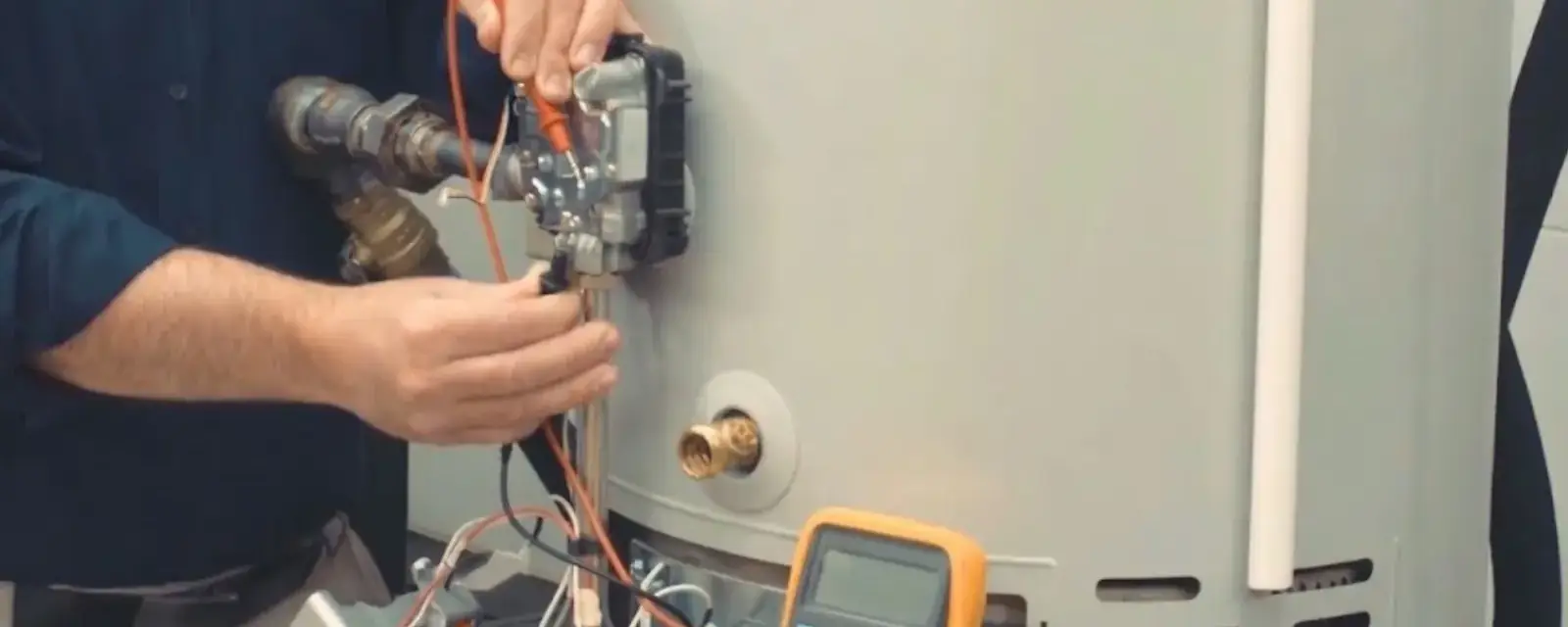
Water heater repair in Carteret, NJ starts with finding out which part failed and whether the tank behind it is still sound. If your heater is leaking, smells of gas or has gone cold in the middle of the night, our 24/7 emergency line is open. Shut the cold supply valve above the tank, turn off power or gas to the unit, and call while you read on.
Most heater failures are small parts. A burned-out element, a worn thermostat, a tired thermocouple or a stuck relief valve each cause a different symptom, and each can be replaced without touching the tank. We test first, explain what we found in plain words, and only suggest a new unit when the steel shell itself has given up.
Water heater leaking or no hot water: what to do first
A heater that is dripping or flooding gets worse by the minute, and a heater that will not light can point to a gas problem. Work through these in order before we arrive, and tell the dispatcher what you did and what you see.
- Close the cold water shutoff on the pipe entering the top of the tank. This stops the refill and limits the spill.
- Electric unit: switch off the dedicated breaker. Gas unit: turn the control knob to off or the pilot setting, and leave the gas valve alone if you are unsure.
- Smell gas? Do not hunt for the cause. Leave the building, get at least 350 feet away, and call PSE&G at 1-800-880-PSEG (7734) or 911.
- Move boxes and stored items off the floor, put a bucket under any drip, and take a photo of the data plate for the dispatcher.
Reading the symptoms before anyone opens a panel
What the heater does tells us where to look. Cold water from every hot tap means the heating side has failed. Lukewarm water that runs out quickly suggests a lower element or sediment. Hot water that is too hot usually points to a thermostat or temperature setting problem.
Noises matter too. A rumble or pop during a heating cycle is sediment cooking on the tank floor. A hiss at the top can be a weeping relief valve or a drop of water landing on a hot burner. A sharp tick from the pipes after use is often just thermal expansion.
- No hot water, electric: dead element, tripped high-limit reset, bad thermostat or a breaker.
- No hot water, gas: pilot out, worn thermocouple, faulty gas control or blocked burner assembly.
- Puddle at the base: fitting leak, drain valve drip or a tank that has rusted through.
- Water running from the relief valve pipe: pressure or temperature fault that should be checked the same day.
Common failures and the usual repair
This table covers the calls we see most. It is a map, not a diagnosis, because we confirm on site with a meter, a gauge and our own eyes.
| Symptom | Likely cause | Typical repair | Tank still good? |
|---|---|---|---|
| Lukewarm water, electric. | One failed heating element. | Replace the element and gasket. | Usually yes. |
| Pilot goes out, gas. | Worn thermocouple or dirty pilot tube. | Replace the sensor and clean the assembly. | Usually yes. |
| Drip at the relief valve. | Faulty valve or high pressure. | Replace the valve, test pressure and expansion tank. | Usually yes. |
| Wet fittings on top. | Loose or corroded connections. | Re-make the joints with new unions. | Yes. |
| Water pooling under the tank. | Corroded inner shell. | No repair possible. | No. |
| Rumbling and slow recovery. | Sediment on the tank floor. | Flush the tank, test the anode. | Often. |
If the steel shell is leaking, no repair will hold. We say so on the spot and show you the evidence.
How a water heater repair visit runs
The order is the same on every call, so you always know what comes next.
Make it safe.
Shut off water, power or gas, contain any leak and check for gas or standing water near electrical parts.
Test the heater.
We measure voltage, element resistance, gas pressure or pilot flame, and check the relief valve and tank condition.
Explain the result.
You hear which part failed, what it costs to fix and whether the tank is worth keeping, before any work starts.
Repair and prove it.
We replace the part, refill the tank, bring it up to temperature and confirm hot water at the tap.
Gas and electric heaters fail in different ways
Electric tanks have two elements and two thermostats. When the upper element dies, you lose hot water altogether. When the lower one dies, you get a short burst of hot water and then cold. Both are quick repairs when the tank is intact.
Gas tanks add a burner, a pilot or ignitor, a thermocouple and a flue. A gas heater that keeps going out can have a weak thermocouple, a draft problem or a gas control on its way out. We check the flue and combustion air as well, because a fault there is a safety matter and not only a comfort problem.
If you are weighing a bigger change, our water heater replacement page explains when a new tank makes more sense than another repair.
Hot water settings, PSE&G and Carteret rentals
New Jersey's plumbing subcode treats hot water as water between 120 and 140 degrees Fahrenheit. If your tap water is far outside that range, the thermostat or mixing valve needs attention. A setting at the low end of that range saves fuel, and a setting that is too low can leave you short on a cold morning.
Natural gas in Carteret comes through PSE&G, so any gas smell goes to PSE&G or 911 first and to us second. We handle the heater, the gas connector and the vent. The meter, the main line and the street piping belong to the utility.
About 45 percent of Carteret homes are rented, so many heaters belong to a landlord. Tell the owner or manager when the water goes cold, photograph the date and any damage, and ask them to approve the call. We give the tenant and the owner the same written findings.
Sources: PSE&G: if you smell gas.
Repair or replace: the rule we use
We compare three numbers: the age of the tank, the cost of the repair and the chance of another failure soon. A new element in a young heater is an easy yes. The same repair in an old, rusty tank buys a short extension.
We lay out both options with a clear price before work starts, so the decision is yours and not ours.
- Under about five years old: repair almost every time.
- Five to ten years: weigh the repair against what could fail next.
- Past ten years with rust or a wet base: replacement is usually the better value.
What affects the price of a water heater repair
We do not guess a number over the phone, because a thermostat and a gas control are very different jobs. You get a clear price before work starts. These factors move it:
- The failed partAn element or thermocouple is a small repair. A gas control or a pressure fault takes more parts and time.
- Fuel typeGas work includes venting and gas connections, and electric work includes wiring and breaker checks.
- AccessA heater in a crawl space, a tight closet or behind a finished wall takes longer to reach.
- Tank conditionSediment, rust or a failing anode can change whether a repair is worth doing.
- Time of callNights, weekends and holidays are emergency visits and are priced as such, with the number given first.
Homeowners insurance often covers sudden water damage but not a worn-out heater, so check your policy. For your real number, call (718) 412-8453.
Keeping a repaired heater running longer
A repair is a good time to fix the habits that wore the heater down. A yearly flush removes sediment, an anode check shows how much protection the tank has left, and a test of the relief valve confirms it will open when it must.
If the heater sits in a basement that sees water, raise the stand and keep stored items off the floor. If the leak may be coming from pipes and not the heater, our leak detection team can trace it. A split supply line is a job for burst pipe repair. A flooded floor in Woodbridge Township or Carteret gets the same night and weekend dispatch.
Code and safety references for water heater repair
Water heater work follows the National Standard Plumbing Code that New Jersey adopts through N.J.A.C. 5:23-3.15, which defines hot water as 120 to 140 degrees Fahrenheit. For gas units, PSE&G's guidance applies if you smell gas: leave, move at least 350 feet away and call 1-800-880-PSEG (7734) or 911.
Water Heater Repair questions from Carteret customers
Do you handle water heater repair emergencies at night or on weekends in Carteret?
Yes. Our line is staffed 24 hours a day, including nights, weekends and holidays, and we book same-day appointments when we can. Tell the dispatcher if the tank is leaking or if you smell gas so we can prioritize correctly.
Can a leaking water heater be repaired?
It depends on where the water comes from. A leak at a fitting, a drain valve or the relief valve can be repaired. Water seeping from the tank body means the inner shell has failed, and the unit has to be replaced.
Why does my gas water heater keep going out?
The usual causes are a worn thermocouple, a dirty pilot tube, a draft problem in the flue or a failing gas control. We test each one and check the vent for safety before relighting.
My electric water heater is only lukewarm. What failed?
One of the two heating elements, or a thermostat, is the common cause. We test them with a meter, replace what failed and confirm the water reaches full temperature.
Is it safe to relight a pilot myself?
If you smell gas, no. Leave and call PSE&G or 911. If there is no gas smell and you know the procedure on the label, it can be done, but a pilot that will not stay lit needs a technician.
What should I do if I live in a rented apartment?
Tell your landlord or building manager right away and keep photos of the leak. We can speak with the owner and give both of you the same findings in plain language.
Do you repair heaters outside Carteret?
Yes. We dispatch from Carteret to Port Reading, Avenel, Woodbridge Township, Fords and Perth Amboy. Port Reading is our closest neighbor and is often the quickest to reach.