
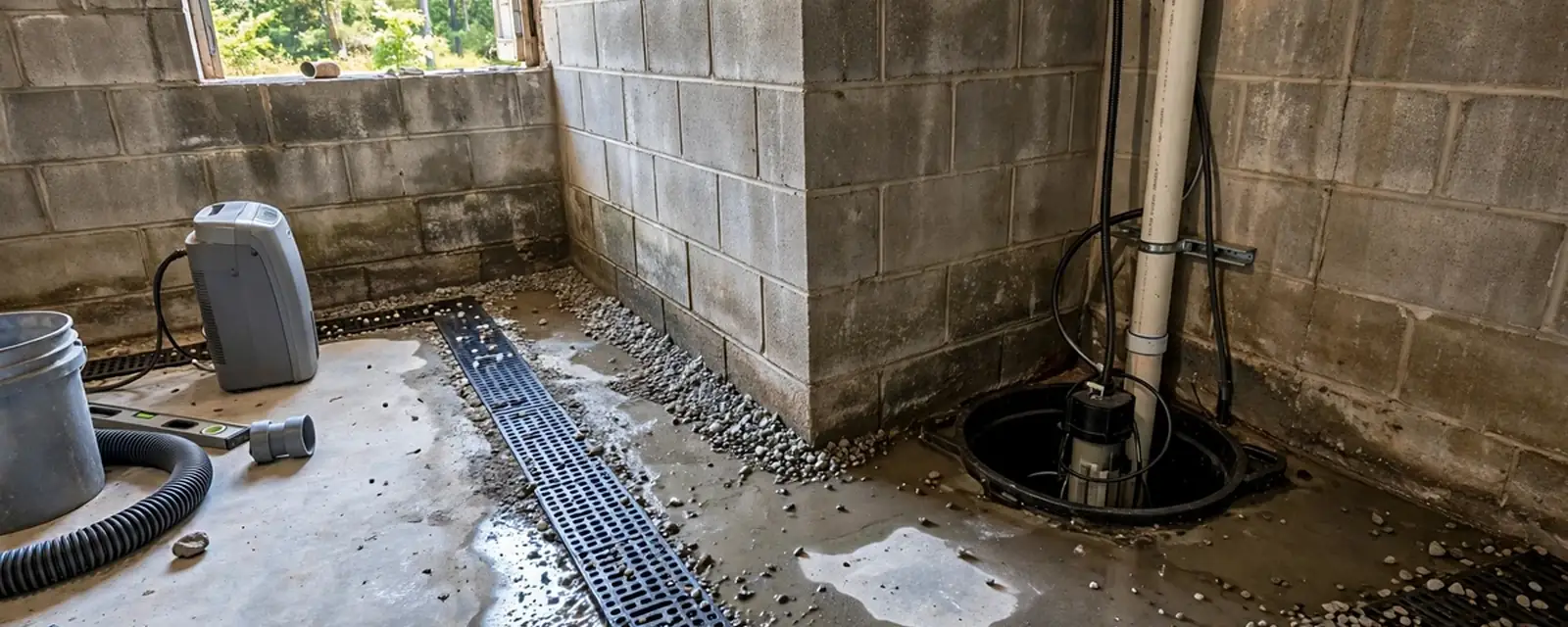
Rubber basement flooring is water-resistant on its surface, but it does not stop water from reaching the slab. It can handle spills, damp air and light moisture better than carpet or wood, yet it will not cure a basement that floods. Fix the source of the water first, then choose the floor.
This guide is for Carteret, NJ homeowners who want a gym, laundry area or workshop below grade. We explain what rubber flooring does well, where it fails, how to test the slab and what to do about moisture before you lay a single tile or roll.
What rubber flooring does well in a basement
Rubber is dense, warm underfoot and does not absorb water the way wood or carpet does. If a washing machine hose leaks or a little groundwater seeps in, the surface wipes clean and does not rot. That makes rubber popular for basement gyms and laundry areas.
- Does not swell or rot when it gets wet on the surface.
- Comfortable and quiet under weights, tools and foot traffic.
- Easy to wipe down after spills and minor leaks.
- Interlocking tiles can be lifted for drying or repair.
- Handles the cooler temperatures of a below-grade room.
Rubber tiles, rolls or mats: which one fits?
The format changes how well the floor handles moisture, because seams are where water travels. Here is how the common forms compare.
| Format | Moisture handling | Best use | Watch for |
|---|---|---|---|
| Interlocking tiles. | Surface water can seep through seams. | Gym, play area. | Seams trap moisture underneath. |
| Rolled rubber. | Fewer seams, better surface barrier. | Gym, large rooms. | Glued edges can fail on damp slab. |
| Loose mats. | Easy to lift and dry. | Laundry area, workshop. | Moisture trapped under the mat. |
| Rubber with drainage backing. | Lets air move below. | Damp-prone spaces. | Higher cost and floor height. |
No rubber floor is a waterproof system. The slab still decides how dry the room is.
Test the slab before you cover it
A simple test tells you whether the slab is dry enough for any flooring. It takes a day or two.
Tape plastic to the floor.
Tape a square of clear plastic, about two feet wide, to the bare slab and seal all edges.
Wait 24 to 48 hours.
Leave the plastic in place without disturbing it.
Check for moisture.
Condensation or a dark patch under the plastic means moisture is coming through the slab.
Repeat after a rain.
Test again after heavy rain, since seepage often shows up only after storms.
Water you cannot see: what rubber will hide
Covering a damp slab with rubber can trap moisture and lead to mold or odor beneath the floor. If you see white mineral powder on the concrete, a damp smell or water marks on the walls, address the water before you cover it.
Our basement waterproofing team looks for the entry point, which might be a crack, a floor joint, a window well or a failing drain. If the cause is a pump that cannot keep up, our sump pump repair service tests the float, check valve and discharge.
- White powder on the concrete: mineral deposits from moisture.
- Water at the wall and floor joint: a common entry point.
- A sump pit that never fills or never empties: pump or drainage trouble.
Choosing a floor for a basement that sometimes gets wet
If your basement takes on water only rarely, a loose-lay or interlocking system is a practical choice, because you can lift it and dry the slab. Avoid gluing rubber over a slab that you have not tested.
Keep stored boxes and furniture off the floor, leave the floor drain uncovered and run a dehumidifier. These small habits do more for a basement than any single flooring choice.
Moisture barriers and subfloor options
If the slab tests dry, a dimpled plastic underlayment under the rubber lets air move beneath the floor and helps any moisture evaporate instead of sitting. This is a common approach in finished basements and works well with loose-lay tiles.
Avoid thick glued systems in a basement that has ever shown water. A floor that cannot be lifted traps whatever moisture arrives, and the repair becomes a demolition job. Plan for access, not permanence.
Drainage, grading and gutters come first
Many wet basements start outside. Gutters that empty beside the foundation, soil that slopes toward the house and a downspout that ends against the wall all send water to the footing. Fixing the outside often reduces what the pump has to handle.
Check that downspouts discharge several feet from the house and that the soil falls away from the walls. These are inexpensive changes, and they protect any floor you put in, whether rubber, tile or vinyl.
Odors, mold and when to stop
A musty smell is a message. If you notice it before you install, trace it to a source. Mold on drywall, damp stored cardboard or a persistent wet patch means water is present and a flooring project should wait.
If you find standing water or active seepage, move electronics and stored items to higher ground and keep power off to wet areas. Call us if the water is rising, since a failed pump during a storm needs help the same day.
Cleaning and care for a rubber basement floor
Rubber needs little care. Sweep, damp mop with mild cleaner and let the floor dry. Lift a few tiles once a year to check the slab beneath for damp spots, dust or a musty smell, and leave the edges unsealed so air can escape.
Strong solvents, oil and heavy point loads can mark rubber, so place furniture on wide feet. If a tile gets soaked, lift it, dry the slab and replace the tile if it stays warped.
Flooding, elevation and basements in Carteret and nearby
Carteret sits on the Arthur Kill, and Hurricane Sandy in October 2012 brought up to 10 feet of flooding to the borough's Public Works building and Waterfront Park, according to the borough's damage report. The borough has also rehabilitated the Roosevelt Avenue and Bergen Street pump stations, with a $4.8 million NJ Water Bank loan closed in October 2020.
Elevation changes the risk. Port Reading sits at about 13 feet above sea level, while Fords stands near 138 feet. About 19 percent of Woodbridge Township is in FEMA flood hazard areas. If you live in a low area, plan for water before you plan the floor.
Basement finishing and electrical or plumbing changes can need permits. Permit rules vary, so ask the Carteret construction office or your plumber before you start.
Source type: Borough flood damage report and state financing announcement. Sources: Borough of Carteret. NJ Water Bank loan, Roosevelt Avenue and Bergen Street pump stations.
Code and safety references for this topic
Flooring does not change plumbing code, but any floor drain or sump work follows the plumbing subcode, N.J.A.C. 5:23-3.15, which adopts the National Standard Plumbing Code. Ask the borough construction office about permits.
Questions readers ask
Is rubber flooring really waterproof?
The rubber itself resists water, but seams, glue and the slab beneath do not. Think of it as water-resistant, not a moisture barrier.
Can I put rubber flooring over a damp slab?
It is risky. Trapped moisture can cause odor and mold under the floor. Test the slab and fix the water source first.
Does rubber flooring help with basement flooding?
No. It will not stop floodwater. A working sump pump and drainage do that, and rubber is a finish layer on top.
Is a Carteret basement more likely to take on water than one in Fords?
Often yes, because Carteret and Port Reading sit near sea level on the Arthur Kill while Fords is on higher ground at about 138 feet. Your lot and drainage still matter most.
Do you test sump pumps in Port Reading or Perth Amboy?
Yes. We serve Port Reading and Perth Amboy and keep the 24/7 line open when water is rising.