
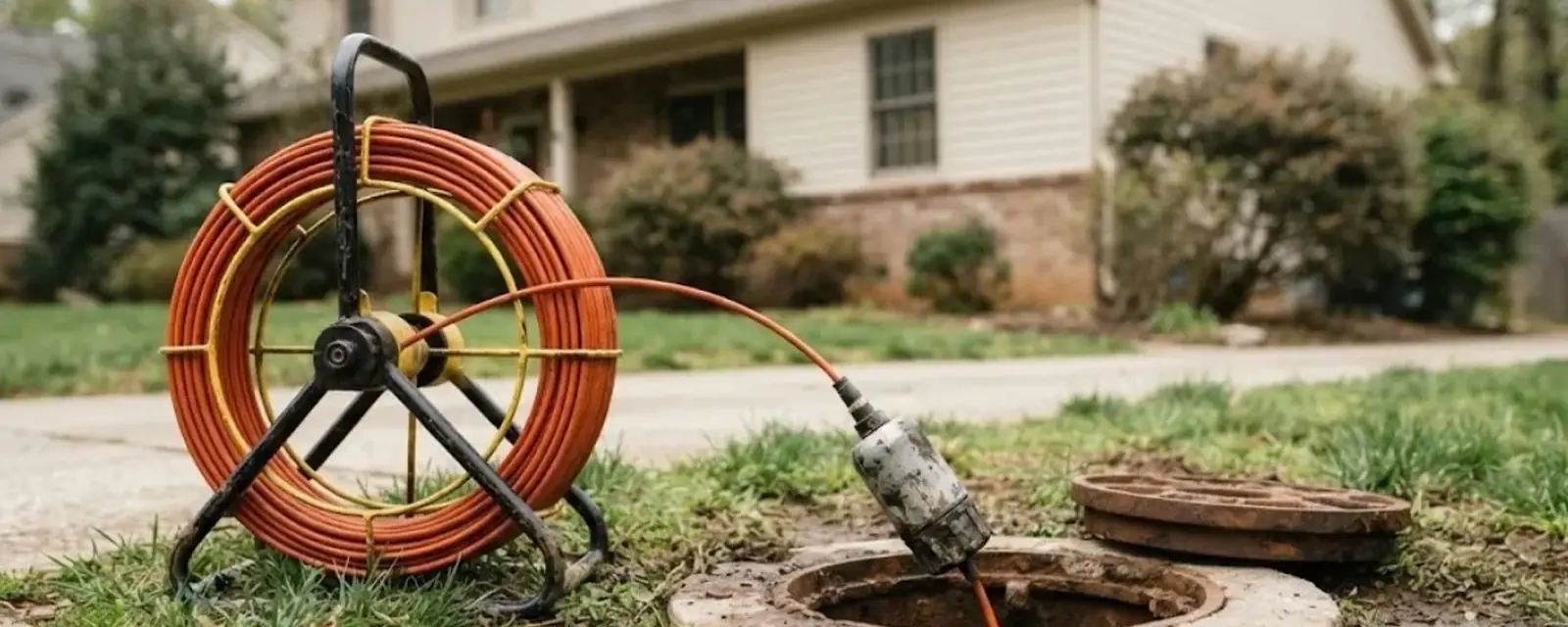
A sewer camera inspection before closing shows the condition of the pipe that carries waste from the house to the street, which a regular home inspection usually cannot see. For buyers in Carteret, NJ, it is one of the cheapest ways to avoid inheriting a cracked, offset or root-filled line. A video of the pipe turns a guess into evidence you can negotiate with.
This guide explains what the inspection finds, how to read the results, and how to schedule one inside a short contract window. If you already own a home and see sewage backing up, call our 24/7 line instead.
What a sewer camera actually looks at
A small waterproof camera on a flexible cable is fed into the line, usually through a cleanout, a vent or the toilet flange. As it travels toward the street it records the inside of the pipe, and a locator can mark where problems sit.
The camera shows the pipe material, the joints, any cracks or offsets, root growth, sagging sections that hold water and buildup on the pipe wall. It does not show what is under every other part of the property, so it is one piece of the picture, not the whole inspection.
- Pipe material and condition of the walls.
- Joints that have separated or shifted.
- Roots entering through joints or cracks.
- Low spots that hold water, sometimes called bellies.
- Where the private line meets the municipal connection.
What the findings usually mean for a buyer
You do not need to be a plumber to read a good report. This table translates the common findings into plain language.
| Finding | What it means | Typical response | Negotiation value |
|---|---|---|---|
| Clear pipe, intact joints. | Line is in good shape. | Keep the video for your records. | Low. |
| Light roots at a joint. | Roots found a small gap. | Cleaning now, monitor. | Medium. |
| Offset or separated joint. | Pipe sections no longer line up. | Spot repair or section replacement. | High. |
| Belly holding water. | Low spot where waste can settle. | Repair if it keeps backing up. | Medium to high. |
| Cracked or collapsed pipe. | Structural failure. | Repair or replacement before closing. | High. |
| Cannot pass the camera. | Blockage or collapse. | Cleaning first, then re-inspect. | Depends. |
A repair estimate attached to the video gives the buyer and the seller a number to discuss.
How to fit an inspection into a contract window
Contract inspection periods are short, so plan the sewer scan at the same time as the home inspection.
Ask for access.
Confirm with the seller or agent that someone will be home and that the cleanout is reachable.
Book early.
Call as soon as the inspection window starts, since scheduling is the usual delay.
Watch or review the video.
Ask to see the footage with a plumber explaining it, not only a written note.
Get any repair price in writing.
Attach the findings and estimate to your request to the seller.
Why a standard home inspection is not enough
A general home inspector looks at the visible plumbing, runs the fixtures and flushes the toilets. A toilet that flushes fine on the day tells you nothing about a pipe that holds waste in a sag or has roots at a joint six feet below the lawn.
Those problems tend to show up weeks after you move in, when a family's full water use finds the weak point. A scan costs a fraction of an emergency sewer repair, and it can show whether you need our sewer line repair service before you sign.
- Ask the seller for any record of past backups or repairs.
- Ask whether the home has a cleanout and where it is.
- Look for newer pipe patches in the basement.
Cleaning versus repair, and which to ask for
If the camera finds only buildup or light roots, a cleaning may be enough for now. Our sewer line cleaning service can clear the line and then re-run the camera to confirm the pipe is open.
If the pipe is cracked, offset or collapsed, cleaning will not hold for long. The next step is a repair estimate, and the buyer can decide whether to ask the seller to fix it, reduce the price or walk away. Our sewer camera inspection service gives you the footage and an honest description of it.
What to do if the report finds a problem
A bad report is not the end of the deal. It is information. Ask the seller for a repair, a credit or a price reduction, and attach the video and the written estimate so the request is specific.
If the seller refuses and the repair is major, you can decide whether the home is still worth buying. A buyer who knows about a collapsed section before closing has far more choices than one who finds it after the first heavy rain.
Keep a copy of the footage after closing. It becomes your baseline, and if a backup happens later, a plumber can compare the new video with the old one to see what changed.
Questions to ask the inspector
A good inspector answers plainly and shows you the footage. Ask them where the cleanout is, how far the camera traveled, whether the whole line to the street was seen, and what they could not see.
Ask whether the inspection was recorded and whether you get a copy. Ask for the estimate for any repair in writing, with the scope clearly stated, so you can compare it with other quotes.
What buyers in Carteret should know about the ground and the system
Carteret sits beside the tidal Arthur Kill, and Hurricane Sandy in October 2012 caused up to 10 feet of flooding at the Public Works building and Waterfront Park. The borough's damage report put about 200 homes as seriously damaged. If a house you are viewing is in a low area, ask about past flooding and about the condition of the sewer and any sump system.
West Carteret lived under a state sewer ban for 25 years, lifted June 26, 2009, because old sanitary and stormwater lines were interconnected and overloaded the pump stations. The public system has since been improved, but a private lateral from the house to the street is still the owner's responsibility.
Nearby towns differ too. About 19 percent of Woodbridge Township is in FEMA flood hazard areas, while Fords sits on higher ground at about 138 feet. Ask the borough or township about floodplain status before you buy.
Source type: Borough of Carteret sewer announcement and Sandy damage report. Sources: Borough of Carteret: West Carteret sewer ban lifted (2009). NJ Water Bank loan, Roosevelt Avenue and Bergen Street pump stations.
Code and safety references for this topic
Sewer repairs that follow an inspection fall under the plumbing subcode, N.J.A.C. 5:23-3.15, which adopts the National Standard Plumbing Code. Call 811 before any digging, and ask the borough construction office about permits.
Questions readers ask
How long does a sewer inspection take?
Most take under an hour once the camera has access to the line. Longer or more complicated runs, or lines that need cleaning first, can take more time.
Who pays for a sewer inspection when buying a house?
It is usually paid by the buyer as part of due diligence, but you can ask the seller to share the cost or provide a recent scan. Sellers who already have a recent video can offer it up front.
Can the inspection be done if there is no cleanout?
Often yes, through a vent or the toilet, though a cleanout makes access easier. We tell you in advance if the house will need one installed.
Do you inspect homes in Perth Amboy and Avenel?
Yes. We serve Perth Amboy and Avenel along with Carteret, and we book same-day appointments when available.
Does Carteret require the owner to fix a failing private sewer line?
The private lateral from the house to the street generally belongs to the owner. Ask the borough construction office how repair work is permitted, since permit rules vary.