
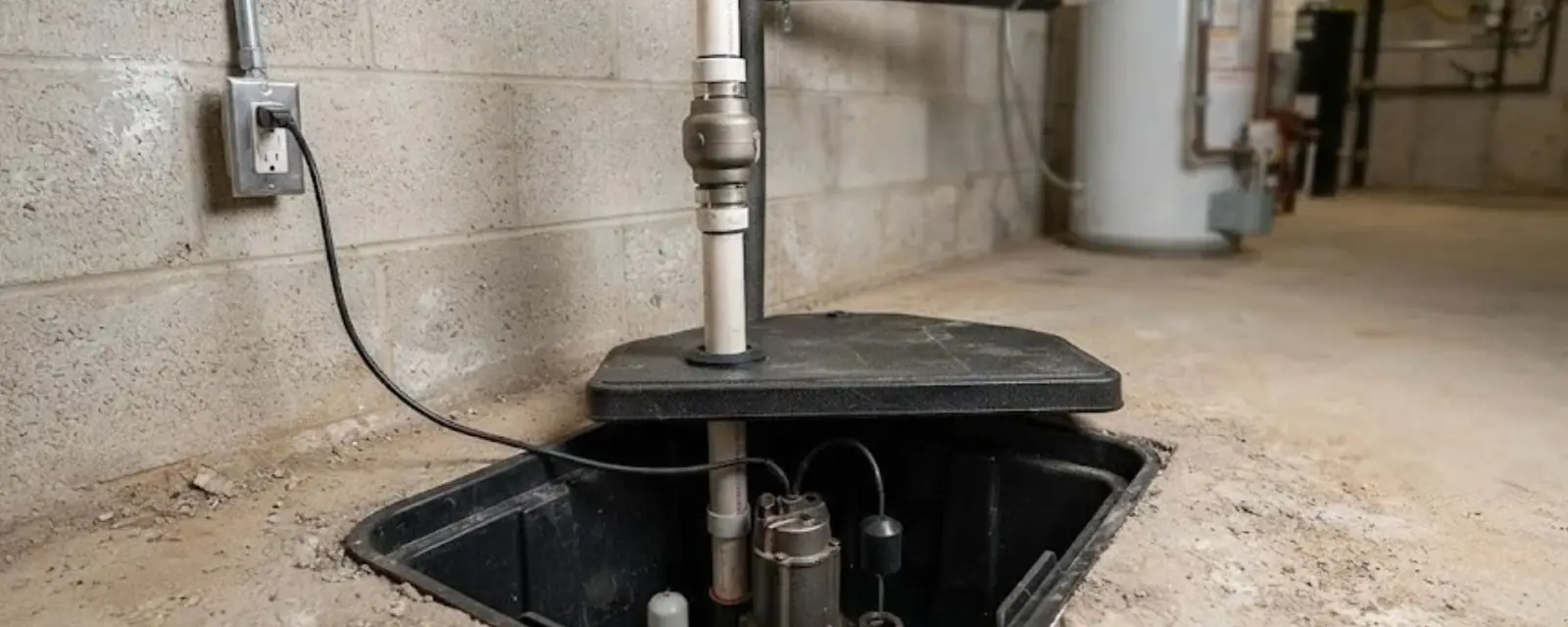
A dual sump pump setup puts two pumps in the same pit, so that if the main pump fails or is overwhelmed, the second one takes over. For Carteret, NJ basements, that backup matters because the borough sits on the Arthur Kill and Rahway River and has a history of flooding in heavy storms. One pump is a single point of failure, and storms are exactly when single pumps fail.
This guide covers how a two-pump system works, what the installation involves, and how to decide whether you need one. If water is already coming into your basement, shut off power to the wet area only if you can do it safely, and call our 24/7 line.
How two pumps share one pit
In a typical dual setup, the primary pump sits at the bottom of the pit and the backup floats a little higher. When the water rises to the first float, the main pump starts. If the water keeps rising, because the main pump has failed or cannot keep up, the second float switches on the backup.
Some homeowners add a battery-powered backup in place of a second electric pump. That protects against power failures, which often happen during the same storm that floods the basement. Which design fits depends on your pit size, your discharge line and how often the power drops where you live.
- Primary pump: handles normal groundwater and ordinary rain.
- Backup pump: takes over if the primary fails, jams or is overwhelmed.
- Separate floats and check valves so one failure does not disable both.
- Optional battery or water-powered backup for outages.
Single pump, dual pump or battery backup?
There is no single right answer. This table lays out how the common setups compare so you can decide what fits your basement.
| Setup | Protects against | Leaves exposed | Best fit |
|---|---|---|---|
| Single pump. | Ordinary groundwater. | Pump failure, stuck float, power loss. | Unfinished basement with little stored. |
| Two electric pumps. | Pump failure and heavy inflow. | Power outage. | Finished basement or frequent heavy water. |
| Electric pump plus battery backup. | Pump failure and power outage. | Long outages that drain the battery. | Homes where outages and storms arrive together. |
| Two pumps plus battery backup. | Most failure modes. | Very little, with maintenance. | Basements with living space or stored valuables. |
Any setup needs a working discharge line that carries water away from the foundation.
What a dual pump installation involves
The visit starts with the pit. We check its depth and width, because two pumps need more room than one. If the pit is too small, it may need to be enlarged or replaced, which adds work and time.
Next we look at the discharge piping. Two pumps usually need separate check valves, and a shared discharge line must be sized so that neither pump pushes water back through the other. We test both floats, run water through the pit and watch both pumps cycle before we leave. Permit rules vary, so ask the Carteret construction office or your plumber how the electrical and plumbing work will be handled.
What to prepare before the installer arrives
A little preparation shortens the visit and helps us quote the right job.
Clear access.
Move boxes and stored items away from the pit and the nearest outlet.
Note the history.
Write down when water last entered, how deep it got and whether the pump ran.
Check the outlet.
A dedicated, grounded outlet is best. Tell us if the existing one is shared with other appliances.
Find the discharge.
Show us where the pipe exits the house so we can check it for blockage or freeze risk.
Signs your single pump is not enough
Some basements tell you before the failure. The pump runs constantly in wet weather, the pit fills close to the top, or the motor is loud and hot. Any of those means the pump is working near its limit.
Water that appears around the pit after a storm, a pump that cycles on and off every few seconds, and a pump older than the rest of the house's plumbing are all reasons to ask about a second pump. A failed unit in a storm can mean flooded drywall within hours, which costs far more than a backup.
- Pump runs nonstop during rain.
- Float sticks or the pump fails to start by itself.
- Water reaches the top of the pit.
- Storm outages have caused a flood before.
Repair or replace the pump you have?
If your existing pump is relatively new and only needs a float or check valve, our sump pump repair team can fix that and add a second pump alongside it. If the pump is old, noisy or unreliable, replacing it as part of a dual installation costs less than doing the work twice.
A wet basement also raises questions about drainage and moisture, and our basement waterproofing service can look at the cause rather than only the symptom. A pump moves water out, but it does not stop it from entering.
Maintenance that keeps both pumps ready
A backup pump is only useful if it works when called on. Once a season, pour a bucket of water into the pit and watch both pumps start in turn. Lift each float by hand to confirm it moves freely, and clean any debris from the pit.
Check that the discharge pipe is clear and ends well away from the foundation. In winter, make sure the outlet is not buried in snow or frozen shut. A pump that runs against a blocked pipe can burn out within minutes.
Why low ground makes a backup pump worth considering in Carteret
Carteret sits beside the tidal Arthur Kill, and Hurricane Sandy in October 2012 showed how fast water can rise. The borough reported storm surge of up to 10 feet of flooding at the Public Works building and Waterfront Park, with about 200 homes seriously damaged.
Today the borough is working on drainage as well. In 2024 the state awarded a $4.1 million Resilient Communities grant toward a $4.7 million bioretention project on Bergen Street, which floods in heavy rain, and the project includes floodproofing the Bergen Street sewer pump station. Public projects like that take years, so a basement that floods on your block still depends on your own pump in the meantime.
Neighboring Port Reading is even lower, at about 13 feet of elevation, while Fords sits on high ground. If you live near the water, a second pump is easier to justify than farther inland.
Source type: Borough of Carteret Sandy damage report and state resilience grant coverage. Sources: Borough of Carteret: West Carteret sewer ban lifted (2009). NJ Water Bank loan, Roosevelt Avenue and Bergen Street pump stations.
Code and safety references for this topic
Sump systems follow the National Standard Plumbing Code that New Jersey adopts through N.J.A.C. 5:23-3.15, and the electrical supply is a separate trade. Permit rules vary, so ask the Carteret construction office.
Questions readers ask
Do I really need two sump pumps?
Not every basement does. If the space is unfinished and nothing valuable is stored there, one reliable pump may be enough. If you have finished rooms, a washer and dryer or stored belongings, a second pump is inexpensive protection compared with a flood.
Can a dual system be added to my existing pit?
Often yes, if the pit is wide and deep enough for both pumps. We measure on site and tell you if the pit needs to be enlarged before we recommend anything.
Will a battery backup work during a power outage?
It can, for the length of time the battery lasts. A battery backup is usually a smaller pump than the main one, so it buys time rather than replacing the primary pump in a long outage.
How fast can you install a second pump near Avenel or Woodbridge?
We book same-day appointments when available, and Woodbridge Township is served from our Carteret base. If your basement is flooding now, call the 24/7 line first.
My Carteret street floods during storms even though my sump pump runs. Why?
The pump may be moving water out while the street or the storm drain sends it right back in. Check that the discharge pipe is not draining toward your own foundation, and report street flooding to the borough's public works department.