
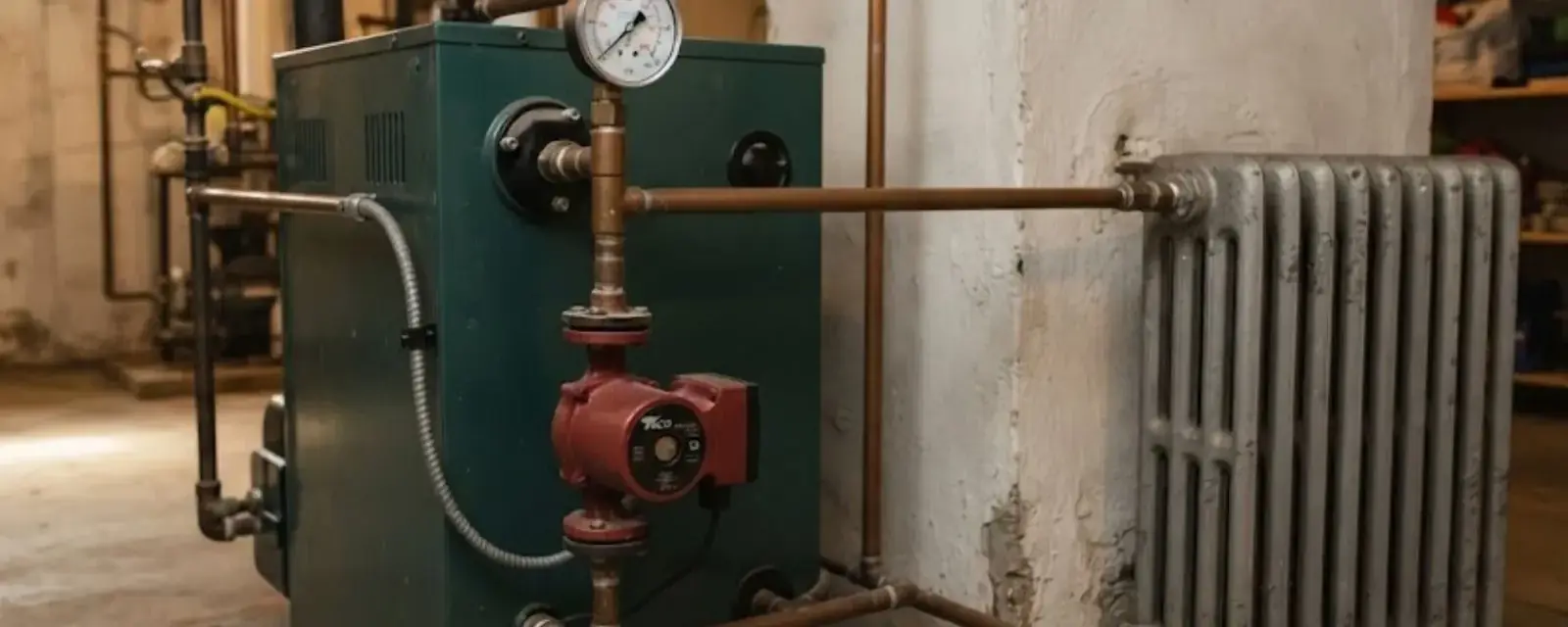
A Crown boiler that stops heating usually has one of a short list of problems: no fuel or power, a tripped safety control, low water pressure, air in the system or a failed circulator pump. Some of those you can check safely yourself. Others involve gas and combustion and should be left to a licensed professional. If you smell gas anywhere in your Carteret, NJ home, leave first and make the calls second.
This guide covers the safe checks, the faults we see most, and how to decide between repair and replacement. We are a plumbing company with a 24/7 line, and we say plainly when a problem needs a heating specialist rather than guessing.
If you smell gas near the boiler, do this first
The rotten-egg smell added to natural gas is a warning, not a puzzle to solve. PSE&G's instructions are clear, and they apply to every gas appliance in your home.
- Leave the building immediately and take everyone with you.
- Move at least 350 feet away before using a phone.
- Call PSE&G at 1-800-880-PSEG (7734) or 911 from outside.
- Do not look for the source, use switches, light matches or start a car near the building.
Checks you can do safely yourself
Most no-heat calls start with simple causes. Before you call, confirm that the thermostat is set to heat and calling for warmth, that the boiler's switch and the nearby breaker are on, and that the gas valve to the boiler is open.
Look at the pressure gauge. Most home hot water systems run at a low, steady pressure when cold, and the manual for your model gives the right range. A reading near zero suggests a leak or a failed fill valve, and a very high reading can mean a failed expansion tank. Do not add water or open relief valves without guidance.
- Thermostat set to heat and above room temperature.
- Boiler switch and breaker on.
- Gas valve open, with no gas smell.
- Pressure gauge reading in the range shown in your manual.
- No water pooling on the floor around the unit.
Common boiler faults and who should handle them
This table sorts the typical symptoms by likely cause and by who should fix them. We confirm on site before recommending anything.
| Symptom | Likely cause | First step | Who handles it |
|---|---|---|---|
| No heat, no sound. | Power, thermostat or safety lockout. | Check switch, breaker and thermostat. | You, then a pro. |
| Radiators warm at the bottom only. | Air trapped in the system. | Do not bleed without guidance. | Plumber or heating tech. |
| Pressure falling over days. | Small leak or failed fill valve. | Look for drips and damp spots. | Plumber. |
| Banging or kettle noise. | Scale or sediment on the heat exchanger. | Turn the unit off. | Heating tech. |
| Water around the base. | Leaking fitting, valve or tank. | Shut off water feed, switch off boiler. | Plumber, urgently. |
| Smell of gas. | Gas leak. | Leave the building. | PSE&G first. |
Leaks, pressure and the plumbing side of a boiler
A boiler is a closed loop of pipes, valves and fittings, and that is where a plumber does a lot of the work. We repair leaking pipe joints, failed isolation and fill valves, and our leak detection crew can trace a pressure drop with no visible drip. We also handle expansion tanks and relief valve discharge lines.
When a fitting is dripping, shut off the water feed to the boiler, switch the unit off at the switch and dry the area. A small drip that goes ignored can turn into a burst joint, so our burst pipe repair line is open day and night if the drip becomes a spray.
Where a plumber stops and a heating specialist starts
Burner adjustment, combustion testing, flue repairs and gas train work belong to technicians with the right equipment and licensing. We do not guess at those jobs, and we will say so if what you describe is outside what we handle.
What we can do is isolate the problem, make the plumbing safe, and tell you whether the boiler needs a heating contractor or a replacement. To check that any contractor is licensed, New Jersey's State Board of Examiners of Master Plumbers lists license holders through the Division of Consumer Affairs lookup.
Repair or replace the boiler
A good rule is to ask for the repair price and the replacement price together. If the unit is old, has a cracked heat exchanger, or has needed two or three repairs in a season, replacement tends to win. A younger boiler with one failed part is almost always worth repairing.
Ask what the quote covers: the unit, fittings, venting changes, disposal of the old boiler and any permit work. A clear written list prevents arguments later.
- Heat exchanger cracked or leaking: usually replace.
- One failed circulator, valve or sensor: usually repair.
- Repeated lockouts and rising fuel use: get a second opinion.
- Permit rules vary, so ask the borough construction office or your plumber how the work will be handled.
Keeping a boiler running through the cold months
A boiler that gets attention once a year tends to fail less often. Schedule a service visit before the heating season, not during a cold snap, when every contractor is booked.
Between visits, keep the area around the unit clear, listen for new noises, and glance at the pressure gauge now and then. Anything that looks different from last month deserves a call before it becomes an emergency.
Gas, permits and licensing for boiler work in Carteret
Gas and electric service in the borough comes from PSE&G. Its published guidance for a gas smell is to leave immediately, move at least 350 feet away and call 1-800-880-PSEG (7734) or 911. That sequence applies to any boiler, furnace or water heater.
The borough's Building, Construction and Land Use Department at the Memorial Municipal Building, 61 Cooke Avenue, reviews plans and inspects permitted work. Permit rules vary, so ask the construction office before a boiler replacement.
New Jersey's plumbing subcode, N.J.A.C. 5:23-3.15, adopts the National Standard Plumbing Code, and the State Board of Examiners of Master Plumbers licenses master plumbers. Always confirm a contractor's license before work starts.
Source type: PSE&G gas safety page and NJ Uniform Construction Code plumbing subcode. Sources: PSE&G: if you smell gas.
Code and safety references for this topic
Boiler repair involves gas and heating rules that we do not summarize here. New Jersey's plumbing subcode is N.J.A.C. 5:23-3.15, which adopts the National Standard Plumbing Code. If you smell gas, leave and call PSE&G at 1-800-880-PSEG (7734) or 911.
Questions readers ask
Why is my Crown boiler not heating?
The most common causes are a thermostat or power issue, a tripped safety control, low water pressure or air in the system. Check the simple items first and call if the unit still will not run.
Is it safe to bleed radiators myself?
Bleeding a radiator is a routine job on some systems, but on others it can drop the pressure and make things worse. If you are not sure how your system is fed, ask before opening any valve.
Should I turn the boiler off if it is leaking?
Yes, switch the unit off, shut off the water feed to it and call. Leaving a leaking boiler running can damage the burner and floor.
Do you service boilers in Avenel and Woodbridge?
We handle the plumbing side from our Carteret base, including Avenel and Woodbridge Township, and we tell you honestly when a heating specialist is needed.
Who do I call first if my boiler stops on a freezing night in Carteret?
If you smell gas, PSE&G and 911 first. If it is a leak or a plumbing fault, call our 24/7 line. Keep taps dripping if pipes are at risk of freezing.